

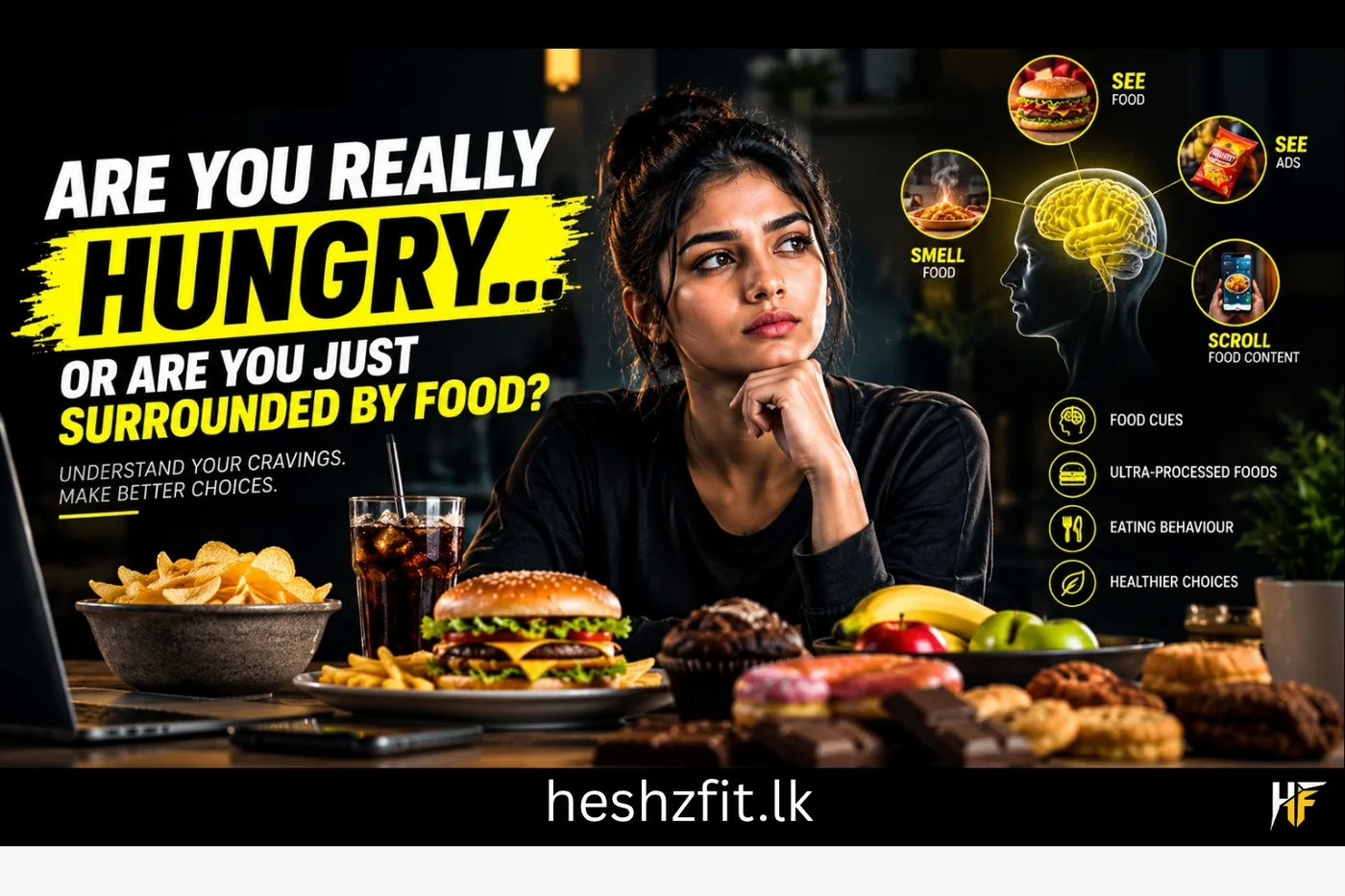
You finish your lunch. You’re not physically hungry. Then you see a packet of biscuits. Someone opens a chocolate bar. You smell freshly made food. You scroll through Instagram and see a food video. Suddenly, you want to eat. But did your body actually ask for food? Modern nutrition research suggests that sometimes, the answer is no. Our eating behavior is influenced not only by internal hunger signals, but also by the environment around us — what we see, smell, remember and repeatedly associate with eating. And this becomes especially important when highly palatable, convenient foods are available almost everywhere.
HUNGER ISN'T THE ONLY THING THAT MAKES YOU EAT#
Your body has internal systems that help regulate food intake. But eating isn't controlled by hunger alone. Research on food-cue reactivity shows that sights, smells and other food-associated cues can increase craving and influence eating behavior. A meta-analysis of 45 studies involving 3,292 participants found that food-cue reactivity and craving were associated with subsequent eating and weight-related outcomes. Think about the difference:
Hunger: "I need food."
Food cue: "That looks really good."
Those two feelings can overlap — but they aren't necessarily the same thing. And modern environments give us an enormous number of food cues.
THE PROBLEM ISN'T SIMPLY "PROCESSED FOOD"#
This part is important. Not every processed food is unhealthy. Food processing exists on a spectrum. Fresh fruit, vegetables, eggs, rice, meat and fish can be minimally processed. Foods such as cheese or some breads can be processed foods without automatically being "junk food." Ultra-processed foods (UPFs) are a different category. Under the NOVA classification, they are industrial formulations made largely from extracted or modified food substances and often contain additives used to create particular flavors, textures or other sensory properties. Examples include many packaged snacks, sugary drinks, confectionery, instant meals and other highly formulated products. So the goal isn't: "Never eat anything processed." The more evidence-based message is: "Don't let ultra-processed foods become the foundation of your diet."
HERE'S WHERE THE SCIENCE GETS REALLY INTERESTING#
One of the strongest experimental studies in this area was conducted by Kevin Hall and colleagues at the NIH and published in Cell Metabolism. Researchers put 20 adults through two different diets for two weeks each: Ultra-processed diet → 14 days Unprocessed diet → 14 days The diets were carefully matched for several nutritional factors, including presented calories, energy density, macronutrients, sugar, sodium and fiber. Participants could eat as much or as little as they wanted. The result? During the ultra-processed diet, participants consumed approximately 508 more calories per day on average. They also gained about 0.9 kg during that period, while they lost about 0.9 kg during the unprocessed-food period. That's important because it shows something beyond simply saying: "People who eat junk food are unhealthy." In a controlled experiment, the type of diet itself affected how much people spontaneously ate. However, this was a small, short-term study, so it shouldn't be interpreted as proving that every ultra-processed food causes weight gain in every person.
WHY MIGHT THIS HAPPEN?#
Scientists are still studying the exact mechanisms. But eating speed and food texture appear to be part of the story. A 2026 randomized crossover trial found that when participants followed two ultra-processed diets differing in food texture and eating rate, the slower-eating diet resulted in approximately 369 fewer calories per day over two weeks. Another randomized study found that a meal composed of ultra-processed foods produced a faster eating rate than a nutritionally matched meal without ultra-processed foods. In simple terms: Food structure → eating speed → how quickly a meal disappears → how much you may eat That doesn't mean texture is the only explanation. Appetite, palatability, energy density, food composition and other factors may all contribute.
AND THEN THERE'S THE FOOD ENVIRONMENT#
Imagine your normal day. You wake up. You see food advertisements. You pass a bakery. You keep biscuits beside your desk. You have snacks available at university. You scroll social media and see food videos. You come home tired. There's an easy-to-eat snack waiting in the kitchen. You don't need to be physically hungry for every one of those cues to influence what you eat. A large body of research shows that food-related environmental cues can challenge the body's internal appetite-control system, particularly in environments where food is constantly available. And newer research continues to support the idea that sensory cues matter. A 2026 systematic review of 43 experimental studies found that food odors commonly increased sensory-specific appetite and craving, although effects on actual food intake were more variable. So your surroundings can become part of your eating behavior.
THIS IS WHY "JUST USE MORE WILLPOWER" ISN'T THE WHOLE SOLUTION#
If highly palatable foods are constantly visible, easily accessible and designed to be convenient, repeatedly relying on willpower may not be the smartest strategy. Instead, change the environment. Keep fruit visible. Keep nuts or other nutritious foods available. Make proper meals the default. Don't keep large amounts of highly tempting snack foods directly in front of you. And most importantly: Build your diet around foods that provide nutrition and satiety, rather than making snacks the center of your eating pattern. Sri Lanka's Ministry of Health has actually made this the focus of National Nutrition Month 2026, with the theme: "Rethink Snacks – Choose Healthy and Natural Snacks." The campaign recommends prioritizing balanced main meals and, when snacks are needed, choosing options such as fruits, vegetables, nuts, pulses, boiled yams and unsweetened dairy products.
WHAT DOES THE BIGGER PICTURE SAY?#
This isn't just about getting lean. A 2024 BMJ umbrella review examined 45 pooled analyses involving almost 9.9 million participants. Greater ultra-processed-food exposure was associated with multiple adverse health outcomes, including higher risks of cardiovascular-disease mortality, type 2 diabetes, obesity and several other outcomes. But there's an important scientific limitation: Most of this evidence was observational, and the researchers rated the quality of many associations as low or very low. So these studies show strong patterns of association, but they don't prove that ultra-processed food alone directly causes every outcome. That's exactly why controlled trials like Hall's study are so valuable. Science isn't about finding one scary food and blaming everything on it. It's about looking at the total evidence.
SO, ARE YOU REALLY HUNGRY?#
Next time you suddenly want a snack, don't automatically label yourself as having "bad discipline." Pause for a moment. Ask yourself: "Am I physically hungry — or did something around me trigger the desire to eat?" Maybe you genuinely need food. Maybe you saw something appealing. Maybe you're bored. Maybe the food is simply available. Sometimes it will be genuine hunger. Sometimes it will be a food cue. Understanding that difference doesn't mean you have to fear food or completely eliminate your favorite snacks. It means you become more aware of why you're eating. Because your food environment is influencing you every day. And if you want better health, better body composition and a healthier relationship with food, you don't only need to change what you eat. Sometimes you need to change what surrounds you. Your environment can shape your choices — so build an environment that makes healthier choices easier.